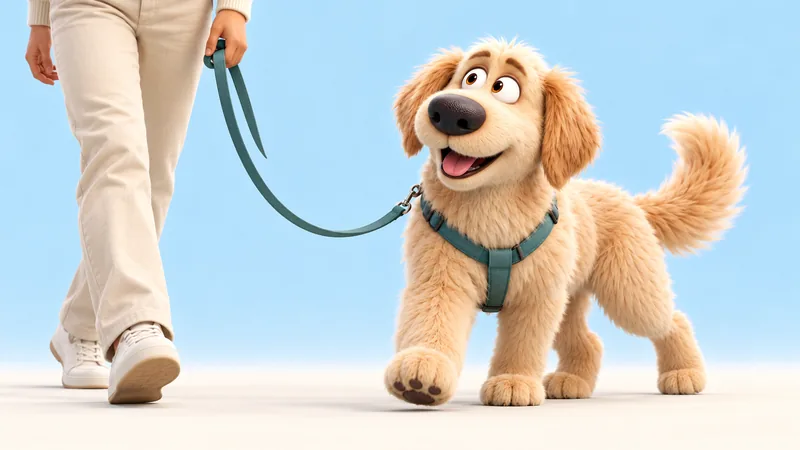
To teach a Labrador to walk without pulling, reward a loose leash before it tightens, practise in an easy place, and increase the challenge gradually. When your dog pulls toward something, avoid making pulling the reliable way to reach it. Pause safely, help them reconnect, and continue when the leash softens. The aim is a comfortable walk with room to sniff, not a dog staring at your knee for the entire outing.
If your Lab lunges, panics, or can pull you off balance, start with a safe management plan and professional support. This guide covers everyday leash skills, not an individualized treatment plan for fear or aggression.
Quick Answer
- Use comfortable, correctly fitted equipment that you can handle safely.
- Teach the walking position in a quiet room or secure garden first.
- Reward a few loose-leash steps, then offer a break.
- Respond before your dog reaches the end of the leash whenever possible.
- Keep practice short and add distance, distraction, or duration one at a time.
- Record where the skill works so you can choose an appropriate next challenge.
Reward while walking comfortably.
Pause when safe, restore slack, and simplify.
Loose-leash walking is a specific skill
Your Labrador may already have plenty of experience moving forward while the leash is tight. That history does not mean the dog is trying to be in charge. It means the journey has often continued during pulling. PDSA explains that pulling can reflect excitement, exploration, or a learned habit, and recommends working with the dog through rewards rather than punishment.1
Define your target in ordinary language: the leash hangs with some slack, you can maintain balance, and your dog can respond when you need to change direction. A dog can be slightly ahead or beside you and still meet that goal. A formal heel is a separate, more precise task.
This distinction helps when evaluating a walk. Two minutes of useful practice followed by a relaxed sniffing break can be a success. Demanding a perfect heel all the way to the park may make both the dog and the handler frustrated before anything is learned.
Prepare a setup you can repeat
Choose a lead and harness or collar that fit your individual dog and are comfortable to use. Inspect clips, stitching, and fit, especially while a puppy grows. A standard fixed-length leash makes the available distance predictable. Battersea describes ordinary leads, appropriate fit, and beginning with manageable conditions.2
Have rewards ready before opening the door. Choose small pieces of food appropriate to your dog rather than assuming that every Labrador needs the same treat. Account for training food in the day’s feeding plan; ask your vet for individual guidance if weight or diet is a concern. PDSA specifically notes the importance of considering reward calories.1
Pick a practice space with enough room to turn without stepping into traffic or another dog. If your pavement is narrow and busy, the first lesson can happen indoors. The location is part of the lesson design, not a test of how much distraction your dog will tolerate.
For a puppy, keep activity appropriate to their health and stage of development. VCA notes that suitable walking duration varies with the individual dog. There is no need to exhaust a puppy before teaching a few walking steps.3
Six steps to build the walking habit
1. Choose a clear reward position
Stand in your easy practice space and decide which side is convenient for the exercise. Reward your dog near that side while the leash is loose. You are giving them a useful place to find you, rather than waiting until they are far ahead and then trying to repair the distance.
Notice your own hand. If the reward is held far in front, your dog may move forward to reach it. If it is held high, the puppy may jump. Deliver it where you want the dog’s head to be, without requiring them to stretch or climb on you.
Practise a few stationary repetitions before walking. The purpose is clarity: when the session starts moving, both you and the dog know where the reward will arrive. You can practise walking on the other side separately when needed; consistency within an early exercise makes it easier to understand.
2. Start with a very small piece of walking
Take one or two steps and reward while the leash is still loose. Stop briefly, reset, and repeat. Increase the number of steps only when the current version is comfortable. RSPCA’s walking guidance emphasizes rewarding the behavior you want and preventing continued progress on a tight lead.4
Use a simple count if it helps your timing: “step, step, reward.” This is an example for the handler, not a required training formula. If you cannot get through the count without tension, make it shorter. If your dog can do it easily, add a small amount of walking rather than immediately attempting the whole street.
Finish while you can still notice and reward useful choices. A short session that you can repeat later is more valuable than continuing until the leash has become tight for most of the exercise.
3. Notice the approach to tension
Watch the leash shape and the dog’s movement, not only the moment your arm gets pulled. If your Lab begins to accelerate toward a smell, you may be able to slow down, turn in a safe direction, or invite them back before the leash becomes tight.
If it does tighten, pause where it is safe. Give your dog an opportunity to turn toward you or move close enough to restore slack. Resume with a small, achievable stretch. Blue Cross describes stopping forward movement when pulling occurs and rewarding a return to a loose lead.5
A pause is not a punishment contest. Do not remain beside a frightening dog or in a dangerous crossing merely to prove a point. Move to safety first, then restart somewhere easier. The training plan should help you make safe decisions, not prevent them.
4. Reward the walking between resets
It is easy to develop an accidental pattern: pull, return, receive food, pull again. If every reward arrives only after pulling, the quiet walking in between may be getting overlooked.
After a reset, look for the next ordinary loose step and reward that too. Gradually build a small stretch of the behavior you actually want. For example, reward the return to your side, then reward another step while your dog is still with you, and then release them to investigate a suitable sniffing spot.
You do not need to keep food pressed against the nose for the whole walk. Keep rewards accessible and deliver them when the dog succeeds. The difference is whether the reward follows a useful choice or is constantly displayed as something the dog must chase.
5. Make sniffing part of the plan
A walk should allow appropriate exploration. Choose places where your dog can sniff safely and use a release cue, such as “go sniff,” to make the change clear. Then bring them back into a short walking exercise when you are ready to move together again.
Picture a simple route with three sections: a quiet stretch for practice, a safe patch for sniffing, and an easy return. It need not cover much distance. This gives the outing a structure without asking your Labrador to maintain the same task from the front door to the end of the walk.
If a particular tree is consistently too exciting, start the walking exercise farther away or choose a less interesting patch first. Distance is an adjustable part of the task. You can work toward the difficult tree later, after building success elsewhere.
6. Transfer the skill gradually
Change one feature of the exercise at a time. A longer stretch in the same quiet place is one change. A new location with a dog passing nearby is several changes at once.
Keep the first repetition in a new place easy. You might ask for only a couple of steps even if your dog managed much more at home. Battersea recommends progressing from low-distraction practice toward everyday walking situations rather than expecting immediate reliability everywhere.2
Write down what made the session harder: bicycles, food on the ground, another dog, a faster walking pace, or a different handler. The note helps you choose the next practice setting. “Needs an easier distance from bicycles” is a workable plan; “ignores everything outside” is too broad to guide the next session.
A practice plan for an ordinary outing
Use this as a flexible example, not an exercise quota. Stop or change the plan if your dog is tired, worried, uncomfortable, or unable to engage.
| Part of the outing | What to practise |
|---|---|
| Before leaving | Check equipment and have rewards accessible. |
| Quiet starting area | A few steps with slack, then a pause or reward. |
| Safe sniffing spot | A clear break from close walking. |
| Easier return stretch | Repeat something your dog already understands. |
| After the outing | Record one success and one situation to simplify next time. |
If an outing must be a quick toilet trip, do not turn it into a prolonged walking lesson. Keep necessary care and formal practice distinct enough that neither becomes unnecessarily difficult. Our house-training guide explains how to organize those toilet opportunities.
Troubleshooting the situations that derail a walk
Your Lab pulls hardest when leaving home
Check the whole departure sequence. Can you attach the equipment and reach a quiet starting place without rushing? A calmer, shorter first exercise may be more useful than repeatedly setting off on the most exciting route. Prepare rewards before the leash appears so you are not trying to organize everything while holding an enthusiastic dog.
Food works indoors but not outside
The outdoor task may be too difficult, or the reward may not be useful in that moment. Move somewhere quieter, shorten the exercise, and observe your dog. Refusing food can occur for different reasons; do not assume the solution is to withhold meals or make the reward more extravagant indefinitely.
Your dog crosses in front of you
Examine your route, reward position, and available space. Practise in a wider area and deliver rewards consistently at the chosen side. Make changes of direction clear and gradual. If the leash is repeatedly tangling around legs, simplify the setup instead of adding speed.
You keep stopping and never get anywhere
That usually means the current exercise is not producing enough successful walking. Choose an easier place, reward sooner, or shorten the stretch. Repeating the same difficult block with increasing frustration is not the only option. A few productive steps in the driveway can be a better lesson than an entire tense route.
Another dog causes barking or lunging
Increase distance if you can do so safely and seek individual help. A dog reacting intensely may need a behavior plan, not simply a different reward position. Do not force close greetings or use passers-by’s dogs as training props without their agreement.
What to measure as progress
Use observations you can repeat: how many comfortable steps you managed in a particular place, whether the dog could turn with you, or whether you noticed tension early enough to adjust. Record the context as well as the outcome. Ten steps in a quiet car park and ten steps outside a crowded shop are different achievements.
You can also measure handler skills. Were rewards ready? Did you choose enough space? Did you end the session before it became unproductive? These improvements can make the next session more consistent even while the dog is still learning.
Avoid a fixed promise such as “no pulling in seven days.” Training history, environment, physical comfort, and individual responses all affect the process. A setback is a reason to review the task, not evidence that a reward-based approach has failed after a predetermined deadline.
Equipment and professional-help limits
Equipment can support handling, but it does not teach the walking habit by itself. Avoid using pain or sudden leash corrections as a shortcut. AVSAB recommends reward-based methods and advises against aversive training tools and techniques.6
Get help if you cannot hold your dog safely, if pulling creates a fall risk, or if your dog shows persistent fear, aggressive behavior, coughing, lameness, or apparent discomfort. Veterinary concerns should be assessed by a vet; handling and training plans should come from a suitably qualified, reward-based professional. This article cannot evaluate equipment fit or diagnose the reason an individual dog pulls.
Frequently Asked Questions
Does my Labrador need to walk at heel the whole time?
No. Loose-leash walking means moving together without persistent tension; it does not require a formal heel throughout the outing. Include safe opportunities to sniff and explore, and use closer walking when the situation calls for it.
Will a harness stop my Labrador pulling?
A suitable harness can support comfortable handling, but equipment does not teach the walking habit by itself. Combine an appropriate fit with reward-based practice, and get individual help if you cannot manage your dog safely.
What should I do when the leash becomes tight?
If it is safe, pause forward progress and help your dog reconnect so the leash can soften. Then restart with a small, achievable stretch and reward loose walking. Move to safety first if you are beside traffic or a frightening distraction.
Why does my dog listen indoors but pull outside?
Outside adds movement, smells, other dogs, and more competing rewards. Begin again with a short exercise in a quieter place and increase difficulty gradually. An indoor success does not automatically transfer to a busy route.
How long should a leash-training session last?
Keep it short enough that both you and your dog can stay comfortable and attentive. A few successful steps can be a complete exercise. Adapt the outing to age, health, and individual needs rather than using a fixed duration for every Labrador.
What if my Labrador lunges at other dogs?
Create distance when it is safe and seek a qualified reward-based trainer or behavior professional. Intense reactions may need an individual behavior plan rather than ordinary walking exercises. Consult a vet if the behavior changes suddenly or discomfort is suspected.
The Bottom Line
Teach the walking you want in small, repeatable pieces. Reward slack before it disappears, provide appropriate sniffing breaks, and choose conditions in which your Labrador can succeed. The practical goal is a safer, more comfortable shared walk, with a training plan that remains manageable for both ends of the leash.
Related
- Labrador recall training — practise returning when called in controlled spaces.
- House training a Labrador puppy — organize toilet trips separately from walking lessons.
- Labrador puppy biting — manage mouthy play and overstimulation.
- Labrador training hub — explore the complete starter collection.
Sources
- PDSA. Training dogs not to pull. Why pulling develops, reward-based practice, and accounting for training food.
- Battersea. How to train your dog to walk on a lead. Equipment, starting conditions, and gradual progression.
- VCA Animal Hospitals. Dog-walking and leash training tips. Adapting puppy walks to individual needs.
- RSPCA. Teaching your dog to walk without pulling. Rewarding loose-leash walking and responding to tension.
- Blue Cross. How to stop your dog pulling on the lead. Stopping progress when pulling occurs and rewarding a loose lead.
- American Veterinary Society of Animal Behavior. Position statements. Reward-based training and the position against aversive methods.