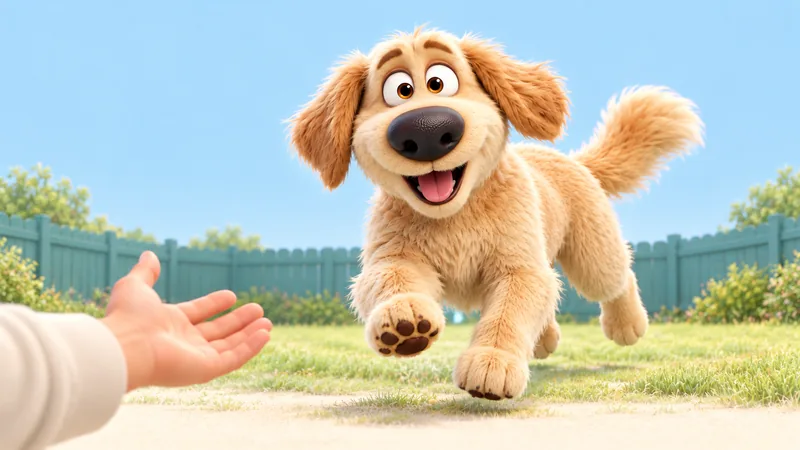
To build a Labrador’s recall, teach one consistent cue in an easy place, make returning rewarding, and practise at gradually greater difficulty while keeping physical control of safety. Start indoors or in a secure enclosed area; use an appropriate harness and training line for suitable outdoor practice. A good response in the kitchen is the beginning of the skill, not permission to unclip the leash beside a road or wildlife.
Recall means returning close enough for you to safely reconnect with your dog. Looking over a shoulder or running past you is useful information, but it is not yet the complete behavior you need.
Quick Answer
- Choose one recall cue that everyone uses consistently.
- Start nearby, in a quiet and secure place.
- Reward the dog when they reach you, including comfortable handling if needed.
- Often release them back to a safe activity so returning does not always end the fun.
- Add distance or distraction in small steps while maintaining safe control.
- If a call fails, simplify the next attempt instead of repeating the cue or punishing the return.
- Start closeQuiet room, easy return
- Change spaceSecure enclosed area
- Go outdoorsSuitable harness and training line
- Add a challengeOne mild distraction; keep safety in place
Decide what a successful recall looks like
Give yourself a clear definition: after hearing the cue, your Labrador turns toward you, travels back, and comes close enough for you to take control comfortably. For everyday use, that final connection matters. A dog hovering just beyond your hand has not completed the same task as a dog who can calmly have the leash attached.
Blue Cross recommends a consistent cue, worthwhile rewards, and including gentle collar handling in practice. It also emphasizes gradually introducing outdoor work instead of expecting the same response everywhere.1
Do not begin by testing the hardest situation you can imagine. A dog sprinting toward another dog is facing a different task from one standing a few steps away in the hallway. Write down the starting condition you can arrange today. “Across the sitting room, without visitors” is a useful training description.
Keep management separate from confidence. Even when training is going well, roads, livestock, unfamiliar dogs, and local leash restrictions still matter. Recall is an additional skill, not a replacement for deciding whether an environment is suitable for off-leash access.
Prepare your cue, reward, and practice space
Choose a cue you can use comfortably and consistently. It might be “here,” “come,” or a whistle signal. Your dog’s name can get attention, but a household often uses a name for many other reasons, so agree which sound specifically means to return.
Choose something your dog values in that setting. Food, a favorite game, or another appropriate reward can help make returning worthwhile. Battersea recommends finding what motivates the individual dog and starting in a comfortable, secure, low-distraction place.2
Keep food rewards suitable for your dog and account for them in the daily feeding plan. You do not need an increasingly large snack each time. A small, engaging reward delivered well can be more practical than fumbling with a full pocket while the dog leaves again.
Prepare the space before beginning. Close doors that lead to hazards, put away distractions you cannot manage, and tell other household members what you are practising. The first lesson should not depend on a toddler remembering to keep an outside door shut.
Six steps for a stronger Labrador recall
1. Make the first returns almost obvious
Start near your dog when they are relaxed and able to notice you. Use a friendly cue, invite them toward you, and reward when they arrive. You are introducing the meaning of a sound, not checking obedience under pressure.
For a simple first exercise, stand a short distance away in a quiet room. When the dog turns toward you, use your chosen cue and make the return easy. Avoid beginning while they are asleep, eating, or absorbed in something difficult to leave. Finish after a few successful repetitions rather than waiting for interest to disappear.
RSPCA describes beginning with an appealing reward and gradually extending the distance before moving into safe outdoor spaces.3 The important progression is from an understandable task to a slightly harder version, not from the house straight into a busy park.
2. Include a comfortable finish near you
Decide where you want the return to end. A practical target is close enough that you can reward calmly and attach a leash if necessary. Deliver the reward near your body rather than throwing it away before the dog has reached you.
If your dog is comfortable with it, pair a gentle touch to the collar or harness with a reward. Introduce that handling separately if reaching makes them duck away, freeze, or become worried. Do not suddenly grab them as they arrive. Blue Cross includes gentle collar handling so a return can lead to practical, safe connection.1
Notice which part needs work. A quick run toward you followed by a wide circle suggests that the arrival needs practice. Repeating longer-distance recalls will not necessarily improve the final few steps. Work close by and make those steps easy and rewarding.
3. Let returning lead to more than the leash going on
After many successful returns in a safe setting, release the dog back to an appropriate activity. Use a simple release word so it is clear when they can go back to exploring. Sometimes the walk must end, but it should not be the only outcome your dog experiences after coming back.
Battersea warns that consistently linking recall with the end of enjoyment can make returning less attractive. Its guidance focuses on maintaining a positive association with the cue.2
A home example is straightforward: call your Labrador away from a mild distraction, reward the return, and let them resume a safe activity. The lesson is not that you will always interrupt something interesting. It is that checking back with you can be part of an enjoyable routine.
Do not use the recall cue to bring the dog over for something they dislike before you have worked on that activity separately. Make grooming, equipment handling, and other care predictable through their own training rather than attaching every difficult experience to “come.”
4. Change distance before adding a busy environment
Once short returns are going well, increase distance within the same easy setting. Then practise in another suitable room or enclosed space, beginning close again. This lets you identify whether the change in location itself is difficult.
Think of distance, distraction, and handler position as separate controls. Calling from farther away while a visitor moves around is more than one increase. If that fails, you will not know which change mattered. Keep two controls easy while adjusting the third.
A useful record might say: “Hallway, three steps away, dog facing partly away; returned promptly.” You can repeat that situation before making it harder. A string of successful returns in similar conditions is more informative than one dramatic success that you cannot reproduce.
5. Use a long line as a safety arrangement, not a steering wheel
For suitable outdoor practice, choose open space well away from roads and other hazards. Blue Cross advises attaching a longer training line to a harness rather than using it on the neck.1 Learn how to manage the line safely before giving your Labrador more distance.
Keep the line clear of legs, other people, and other dogs. Do not wrap it around your hand or let your dog build speed toward the end. Choose a manageable amount of line and ask a qualified trainer to demonstrate handling if you are unsure. A longer line is not automatically a safer choice in a crowded or awkward space.
Arrange easy returns within the distance you can manage. The line prevents an unplanned escape; it should not drag the dog through the exercise. If you are repeatedly hauling them back, simplify the setting and seek help with the setup.
Give other walkers space. Do not allow a training line to cross a path or invite your dog toward someone else’s dog as an uncontrolled distraction. Your training session should remain predictable for the people and animals around you.
6. Practise decisions before increasing freedom
Before calling, ask three questions: can my dog notice me, can they safely get back, and am I ready to reward the return? If any answer is no, change the setup rather than spending the cue on a task that is currently too difficult.
Introduce mild distractions at a distance where the dog can still respond. For example, observing quiet activity far away is a different challenge from being inside it. Keep physical control, and reduce the difficulty when responses become slower or less complete.
Do not treat a few good repetitions as proof of universal reliability. Keep using secure spaces and suitable leash arrangements while you build a history across conditions. The decision to allow off-leash activity must also account for the location, other animals, applicable rules, and your ability to prevent harm if the recall fails.
A simple recall practice session
This example organizes a short session; it is not a promise of progress after a certain number of days. Choose fewer repetitions if your dog becomes tired, worried, or distracted.
| Part | What to arrange |
|---|---|
| Set up | Quiet space, safe boundaries, cue and reward agreed. |
| Easy start | A few nearby returns your dog already understands. |
| One small change | Slightly more distance or one mild distraction. |
| Finish near you | Reward arrival and comfortable reconnection. |
| End | Release to a safe activity and note what worked. |
Keep your notes brief enough that you will actually use them. Record the location, approximate distance, distraction, and outcome. Add whether the dog came all the way in. That last detail keeps a partial response from being mistaken for the complete recall.
What to do when your Labrador does not come
Avoid repeating the cue continuously
One unanswered call tells you something about the current task. Repeating it louder several times does not automatically make the cue clearer. If you have safe physical control, calmly reduce the distance or difficulty and reset. Blue Cross advises returning to a level at which the dog was responding reliably.1
When immediate safety is at risk, prioritize safely securing the dog and getting assistance. That situation is not the time to insist on finishing a training exercise. Afterwards, review how to prevent another unprotected failure.
Reward the return even if it was slow
Do not punish a dog once they finally reach you. That makes the moment of returning unpleasant. RSPCA explicitly advises praising returns and avoiding the pattern in which recall predicts reprimands or only the end of off-leash time.3
You can be pleased that the dog is safe and still recognize that the exercise was too hard. Those are compatible decisions: acknowledge the return, then plan an easier next repetition. Training notes are a better place for your frustration than the arrival moment.
Separate a slow turn from an incomplete arrival
A dog who does not turn toward you needs a different adjustment from a dog who turns promptly but stops out of reach. For the first pattern, reduce competing distractions or work closer. For the second, make the final approach and comfortable handling more rewarding in an easy setting.
This is why a simple pass/fail tally can hide useful detail. Write “looked immediately, stopped two steps away” instead of “failed.” Your next session can then target the actual gap rather than repeating the whole sequence unchanged.
Check whether the cue has become predictable in the wrong way
If “come” is mainly heard before leaving the park, your dog may anticipate that outcome. Add easy, rewarding returns during safe activities and often release them again. If you decide to introduce a fresh cue, teach it from the beginning; a new word by itself does not change the training history.
Measuring progress without overestimating reliability
Look for prompt orientation, a direct return, a comfortable finish, and repeatability in a described situation. Keep the conditions attached to the result. “Reliable indoors when quiet” is an honest stage of progress, not a failure to have reached an all-purpose recall.
A helpful next step is the smallest change that preserves those qualities. If distance increases and the finish falls apart, shorten it again. If a different handler struggles, have them begin with the easy version rather than assuming that everyone’s timing and cues are identical.
There is no breed-wide date at which a Labrador becomes safe off leash. Build the skill and continue managing the environment. Reward-based training is the approach recommended by AVSAB; pain or intimidation is not an appropriate shortcut for an unreliable recall.4
When to seek individual help
Work with a qualified reward-based trainer if your dog repeatedly bolts, chases animals, cannot cope with outdoor distractions, or makes long-line handling unsafe. A dog who is frightened of approaching or being touched also needs a more individualized plan than adding stronger rewards at greater distances.
A sudden change in responsiveness can have causes beyond training. If your dog appears unwell, painful, disoriented, or less able to hear, consult your veterinarian. This guide cannot assess those possibilities or certify that a dog is safe to be off leash.
Frequently Asked Questions
What is the best recall word for a Labrador?
Choose a clear cue that everyone can use consistently, such as “here” or “come,” or a whistle signal. The training history matters more than the particular word. Teach the cue in easy situations before relying on it around distractions.
Should I keep calling if my dog does not come?
Avoid repeating the cue continuously. Maintain safe control, reduce the difficulty, and return to a version your dog understands. If there is immediate danger, prioritize safely securing the dog and getting assistance rather than completing an exercise.
Should I reward a slow return?
Yes. Make reaching you a positive outcome even if the response took longer than you wanted. Then simplify the next attempt. Punishing arrival can make the dog less willing to approach the next time you call.
Can I practise recall with a long line?
Yes, in a suitable open area away from roads and other hazards, using a correctly fitted harness and safe line handling. The line manages safety; it should not be used to drag the dog through the exercise. Ask a trainer for a demonstration if handling it is difficult.
When is my Labrador ready to be off leash?
There is no age or short run of successful recalls that guarantees safety. Consider reliability across the relevant conditions, the location, other animals, and applicable leash rules. Continue using secure spaces or appropriate leash management wherever failure could put anyone at risk.
Is it too late to teach an adult Labrador recall?
No. Begin with short, easy returns and build a rewarding history with a consistent cue. Adjust the plan to the dog’s existing habits, comfort, and health. Seek individual support if chasing, fear, or unsafe handling makes practice difficult.
The Bottom Line
Build a recall your dog understands before asking it to compete with a busy world. Make returning worthwhile, practise the final approach as well as the turn, and keep physical safety in place while you add challenges. The best next repetition is one you can arrange thoughtfully, not the biggest test you can find.
Related
- Loose-leash walking for Labradors — create calmer, more manageable outings.
- House training a Labrador puppy — organize the first daily routines.
- Labrador puppy biting — guide mouthy play toward better outlets.
- Labrador training hub — the complete starter collection.
Sources
- Blue Cross. Dog recall training. Cue consistency, rewards, gentle handling, long-line safety, and simplifying failed attempts.
- Battersea. How to teach your dog a recall. Positive associations, appropriate rewards, and starting in secure, quiet places.
- RSPCA. Teaching your dog to come when called. Progressive practice, safe outdoor spaces, and rewarding the return.
- American Veterinary Society of Animal Behavior. Position statements. Reward-based training and the position against aversive methods.